






The Art of Labor: How Modern Straight Razor Designs are Built to Last

This Labor Day, we’re celebrating the spirit of real craftsmanship—the kind of grit, sweat, and dedication that turns raw metal into a tool meant to last a lifetime. In a world full of "good enough" disposable plastic, there’s something undeniably satisfying about picking up a tool that was actually shaped and honed by human hands. Appreciating modern straight razor designs means looking at the calloused hands, the searing furnaces, and the generation-spanning techniques that forge them.
The truth is, the best razors aren't just churned out by a soulless machine on an automated factory line. They are the direct result of a master bladesmith who really knows their way around a roaring furnace, an anvil, and a spinning grinding wheel. When you choose a traditional straight edge razor, you aren't just buying a daily grooming instrument; you are honoring a legacy of physical labor.
Sure, shaving with a straight razor requires more skill to master than dragging a cartridge across your face, but the payoff? An extremely close shave and a superior shave that makes multi-blade disposable razors feel like a bad joke.
- Why Switch to a Straight Razor?
- Beyond the Disposable: Why Craftsmanship Matters
- Straight Razor Designs: Getting to Know the Artisan's Choices
- Step-by-Step Masterclass: How to Shave with a Straight Razor
- Caring for Your Straight Razor: Respecting the Steel
- Honoring the Craft This Labor Day
Why Switch to a Straight Razor?

If you’ve been on the fence about straight razor shaving, this Labor Day is the perfect time to commit to the upgrade1. Beyond the satisfaction of mastering a classic ritual, the practical advantages of a straight razor are directly tied to the physical labor invested in its creation:
-
Unmatched Precision
Hand-ground straight razors allow absolute geometric control. This precise shaving ability helps you save time on touch-ups, outline beards cleanly, and reduce nicks once you establish your rhythm.
-
Skin Health
Because you are gliding a single blade—expertly hollowed and honed—across your skin rather than dragging 3 to 5 dulling cartridge blades that pull facial hair, you’ll experience significantly less skin irritation, razor burn, and fewer ingrown hairs.
-
Economic & Environmental Value
While a handcrafted razor requires a higher initial investment, it is far more economical in the long run since you stop purchasing expensive recurring refills. Furthermore, keeping a single forged blade in service for a lifetime eliminates endless plastic and metal cartridge waste, making it a truly environmentally-friendly choice for your daily grooming routine.
Beyond the Disposable: Why Craftsmanship Matters
Ever noticed how most modern grooming tools feel like they’re destined for a landfill the moment you open the box? That’s because mass-market disposable razors, plastic safety cartridges, and cheap replaceable blades are engineered for short lifespans and continuous recurring purchases.
A high-quality, solid-forged standard straight razor is a completely different beast. Instead of relying on thin, temporary replaceable blades, a handcrafted razor serves as a permanent bridge between old-school industrial masters and your own bathroom counter—elevating the daily wet shaving routine into something deeply personal and meaningful.
When a razor blade is crafted and finished by hand, it isn't about hitting an aggressive hourly manufacturing quota. It is about an artisan focusing on time-tested principles that turn raw steel into an heirloom:
-
Material Integrity
Only premium carbon steel, stainless steel, and specialized alloys are selected. Each demands custom heat-treatment cycles and precise temperature monitoring that no mass-production line can replicate.
-
Molecular Alignment
High-impact forging2 aligns the metal grain structure, eliminating internal voids and making the blade tougher and sharper from the moment it leaves the forge.
-
The Artisan's Ear
A master grinder listens to the steel as it presses against the stone, judging geometry and wall thickness by the micro-vibrations and auditory resonance of the blade.
-
Built for Longevity
Because an artisan spent hours aligning the molecular structure during forging, the blade possesses structural integrity that cheap plastic entirely lacks. A well-crafted straight edge razor can last for decades with proper care.
The Forging Process: From Red-Hot Blank to Heirloom
 Transitioning from the heat of the forge to the bench, a master artisan carefully grinds and shapes the raw steel blank—one of the essential manual steps in forging a shave-ready heirloom.
To appreciate these tools this Labor Day, we step inside the workshop to trace how raw steel transforms into a shave-ready instrument.
1. Forging the Blade in the Heat
The journey starts with solid steel billets or blanks. The bladesmith places the metal into a furnace, heating it up to nearly 2,000°F until the steel glows cherry-red. Working against cooling air, the smith uses a heavy hammer to beat the raw blank into its rough silhouette.
This physical labor does more than shape the metal—it compresses the steel's molecular structure, refining the grain structure, removing internal voids, and preparing the blade to take a keen edge.
2. Hardening and Quenching: The High-Tension Quench
Once shaped, the blade undergoes critical heat treatment. Coated in protective compounds to prevent scaling, the red-hot blade is dipped into high-temperature salt baths and plunged into a controlled oil quench.
This extreme thermal shock locks the steel into a glass-hard state. The internal tension is immense, and the blade can easily warp or crack. A veteran smith must evaluate the warm blade instantly, using gentle, experienced hammer taps or manual straightening jigs to correct any warp before the steel freezes permanently.
3. Shaping and Grinding: Listening to "Singing" Steel
After tempering to relieve internal stress, the master grinder takes over. Holding the bare steel against coarse-to-fine stone wheels, the grinder carves out the hollow profile.
A true artisan doesn't rely solely on sight; they listen. As the steel thins toward a full hollow geometry, the metal begins to produce a distinct "singing" pitch against the stone. This auditory feedback tells the craftsman exactly when the steel has achieved optimal elasticity.
4. Polishing and Finishing
The ground blade moves to polishing wheels loaded with fine abrasive pastes, working up to a mirror-like polished steel finish. Polishing isn't just aesthetic—a smooth, polished surface minimizes friction against the skin and seals microscopic pores against rust.
5. Attaching the Scales and Final Inspection
Finally, the artisan fits the carved handle, inserts the pivot pin, and peens it by hand using a ball-peen hammer. The blade is inspected under magnification, hand-honed on fine stones, and tested to ensure it meets strict shave-ready standards. Master historical cutlery houses like Thiers Issard have preserved these exact manual steps for over a century.
Straight Razor Designs: Getting to Know the Artisan's Choices
Before you start your journey, it helps to understand that every design specification on a straight razor represents a conscious, high-stakes decision made by a craftsman at the workbench. Straight razors differ fundamentally by their point shape, blade grind, blade width, and handle material.
Blade Width and Material: Heat Control and Forge-Welding
 Whether bound for classic carbon, relentless stainless, or folded Damascus steel, every blade starts as a raw forged blank awaiting its specific heat cycle.
A razor's blade width is measured in eighths of an inch. While widths typically range from 3/8 to 6/8 inches (and up to 7/8 or 8/8 inches for specialized custom tools), the 5/8-inch blade is the most common benchmark for beginners—offering a "Goldilocks" balance of weight, visibility, and control.
However, the true narrative of labor lies in how the bladesmith manipulates the blade material under punishing heat and heavy hammers:
-
Carbon Steel Blades
The classic choice for traditionalists. Carbon steel blades are known for their smooth shaving properties and keen edge retention. But carbon steel demands relentless heat control in the forge; a few degrees too hot, and the grain structure coarsens, ruining its edge retention. Because it is susceptible to rust, carbon steel blades require more care and oiling than stainless steel.
-
Stainless Steel Blades
A low-maintenance, rust- and acid-resistant hero for the user. For the smith, however, stainless steel alloys are exceptionally stubborn, requiring far more mechanical force to hammer, shape, and grind.
-
Japanese Steel Blades
Renowned for extreme purity and high carbon content. Japanese steel blades are capable of taking a razor-sharp, keen edge, but require meticulous, multi-stage heat cycles and clay-tempering techniques.
-
Damascus Steel Blades
The ultimate showcase of physical labor. Damascus isn't simply poured—it is created by hand-folding, stacking, and forge-welding alternating layers of hard and tough steels over dozens of hours. The smith wields a heavy hammer against blistering heat to produce a distinct, wavy pattern and a microscopic, saw-like edge structure.
The Grind: A High-Stakes, Manual Art
 Whether shaping a sturdy wedge or a paper-thin full hollow profile, blade grinding is a high-stakes manual art where a single slip against the wheel instantly ruins the steel.
The blade grind defines the profile, elasticity, and sharpness of the razor. Shaping a hollow grind blade is not a task for automated robots; it is a high-stakes manual art where one slip against the spinning wheel ruins hours of forge work.
-
Wedge or Flat Grind
The thickest and most rigid option. The wedge grind requires heavy stone grinding to remove excess mass while leaving a stout spine, making it ideal for cutting through coarse beards.
-
Quarter & Half Hollow Grind
Achieving a quarter or half hollow profile demands incredible discipline at the grinding wheel. Rather than grinding away all excess mass, the craftsman must rely on refined hand-eye coordination and muscle memory to hold a precise curve against larger-diameter stones. It requires physical stamina to maintain even pressure down the entire length of the blade, ensuring the steel retains enough backbone for heavy growth while carving out just enough hollow geometry for smooth feedback.
-
Extra Hollow & Full Hollow Grind
Grinding a full or extra hollow blade is an extraordinary display of manual dexterity. The artisan thins the steel until it is paper-thin and flexible. One heavy hand or wrong angle on the grinding wheel will instantly snap the ultra-thin steel, destroying a nearly finished blade in a fraction of a second.
Scale Material: Balance, Weight, and Lifespan
 From dense hardwoods to modern acrylics: scale materials are selected and shaped by hand to ensure optimal weight distribution and long-term durability.
The handle—historically known as the scales—does more than protect the edge when folded. Shaping scales is an intensive exercise in woodworking and benchwork craftsmanship:
-
Traditional Organics
Dense exotic wood, genuine animal horn, and bone are hand-carved, slowly sanded through multiple grit stages, and sealed by hand. Artisans spend hours navigating grain direction, heat sensitivity, and natural flaws to unlock a warm, classic feel.
-
Modern Synthetics
Water-resistant resins, acrylics, G10, and carbon fiber are hand-shaped and polished to tight tolerances, requiring steady hands to prevent heat-melting during high-speed sanding.
-
Custom Finishes
Custom straight razors feature hand-carved spine work, ornate tang engravings, and meticulous scale inlays using raw materials like abalone shell or blond horn.
-
Manual Counterbalancing
Aligning scales isn't calculated by computer modeling—it relies on the artisan's tactile intuition. The craftsman manually shapes, sands, and tests the weight distribution of the scale materials until they perfectly counterbalance the forged steel blade, ensuring the razor pivots weightlessly in your hand without requiring downward forcing pressure.
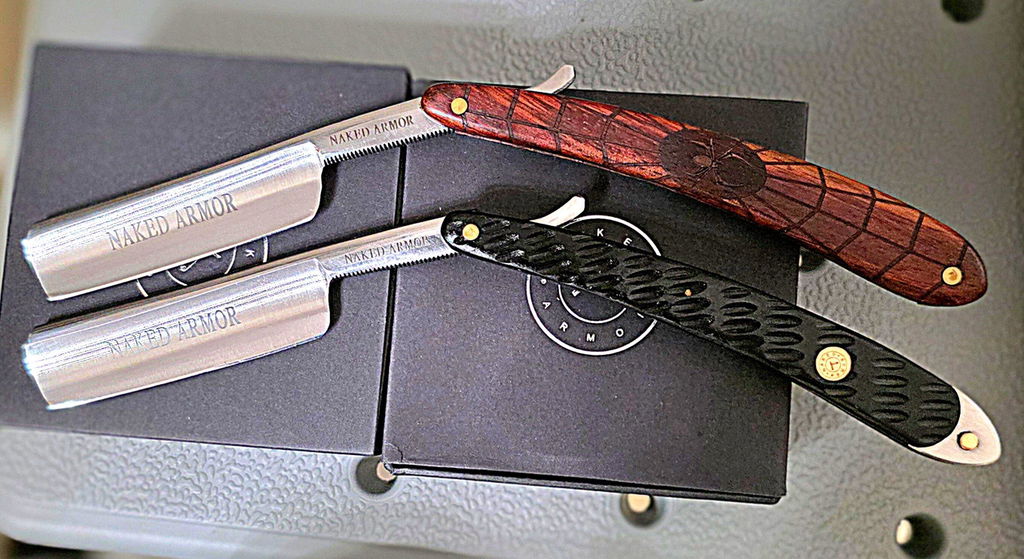
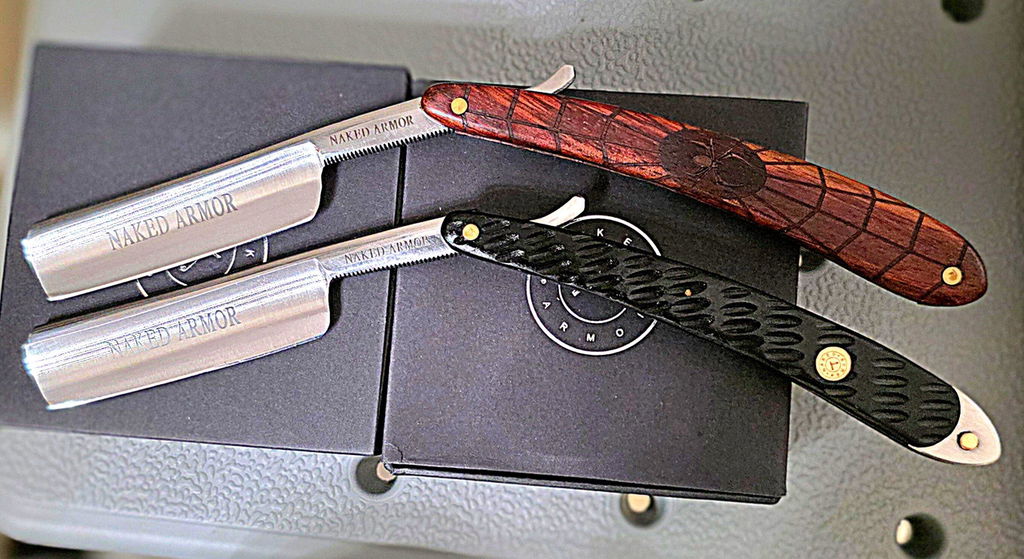
The Essential Parts of a Handcrafted Razor
 From hand-ground point geometries to hand-peened pivot pins, every individual component of a straight razor reflects hundreds of manual file strokes, hammer strikes, and wheel passes.
Every individual component on a straight razor is a testament to hands-on physical labor—a physical record of the smith’s hammer, the grinder’s wheel, and the bench artisan's files:
-
The Blade
The central forged body featuring the cutting edge, spine, and point—hammered under intense furnace heat and ground by hand against stone wheels.
-
The Point Shapes
Hand-ground point geometries dictate how you maneuver around facial contours:
- Round Point: Carefully rounded on the grinding wheel to eliminate sharp corners, reducing accidental jabs for beginners.
- Square Point: Hand-filed to a razor-sharp 90-degree corner, providing unmatched precision for beard profiling and crisp line work.
- French Point: Requires steady hands to ground a subtle inner curve leading into a precise tip, balancing safety and control.
- Spanish Point: A masterclass in wheel control, featuring a deep concave scoop hand-ground near the tip for high visibility around tight facial contours.
-
Barber's Notch: A small cutout filed or ground directly into the point area, historically crafted to allow barbers to quickly hook and swing the blade open with one thumb during rapid shop work.
-
The Spine
The thick upper edge of the blade. The smith must manually grind the spine completely flat and parallel to the edge using precise hand pressure on flat stones, establishing the permanent angle guide required for future stropping and honing.
-
The Tang & Jimps
The shank extending from the blade. To ensure a safe, non-slip grip when wet, the craftsman hand-files or machine-presses tiny ridges—known as jimping—into the underside or top edge of the tang.
-
The Pivot Pin
A small brass or steel rivet driven through the scales and blade. The artisan must hand-peen this pin using rhythmic, light strikes from a ball-peen hammer—balancing precise tension so the blade opens smoothly without wobbling or dropping free.
Step-by-Step Masterclass: How to Shave with a Straight Razor
Shaving with a cut-throat razor is a rewarding skill that honors the craftsman's labor:
-
Prep the Skin
Wash your face with warm water or apply a hot towel to open pores and soften beard hair. Apply a slick pre-shave oil to create a protective barrier.
-
Build the Lather
Use a quality shaving brush and shaving soap to whip up a dense lather. Apply in circular motions to lift hairs away from the skin.
-
Set the Angle
Hold the razor comfortably with your fingers on the tang and your thumb underneath. Angle the blade at roughly 30 degrees relative to your skin.
-
Stretch and Glide
Pull your skin taut with your free hand to prevent bunching. Let the natural weight of the steel do the work—glide the sharp blade downward in short, controlled strokes with the grain.
-
Rinse and Soothe
Rinse with cold water to close pores, pat dry, and apply a soothing, alcohol-free aftershave balm.
Caring for Your Straight Razor: Respecting the Steel
A handcrafted razor requires dedicated upkeep to maintain its performance for decades:
-
Stropping the Blade
Before every shave, draw the blade across a leather strop. The stropping process does not remove metal; instead, it realigns microscopic teeth along the cutting edge that bend during shaving, ensuring a comfortable shave every time.

-
Honing the Edge
When stropping no longer restores keenness, honing is required. Honing uses synthetic or natural waterstones (typically 8,000 to 12,000 grit) to remove a micro-fraction of metal and restore a shave-ready edge. Remember, a dull blade is more dangerous than a sharp blade because it causes pulling and forces heavy-handed pressure.

-
Storing Your Razor
Always store your razors completely dry in a well-ventilated area away from bathroom humidity. Apply a light coat of mineral oil to carbon steel blades between uses to prevent rust.
Honoring the Craft This Labor Day
This Labor Day, take a moment to reflect on your morning routine. You can continue rushing through it with disposable plastic tools designed for short lifespans—or you can adopt a ritual rooted in history, metallurgy, and human effort.
When you hold a well-balanced straight edge razor, you hold hours of physical craftsmanship: the furnace glare, the hammer strikes, and the keen ear of a master grinder. It’s time to stop rushing through the morning and start appreciating the craft. Explore our complete straight edge razor collection to find a tool built to last a lifetime.
More Naked Armor Related Articles
A Guy's Grooming Tips for the Labor Day Weekend
Grooming Tips for Men: How to Look Sharp and Stay Cool This Summer
How to Shave with a Straight Razor for Summer Vacation Travels
References
- Bates, C. (2026, July 1). 11 reasons to choose a straight razor shave. BreakingAC. https://breakingac.com/news-from-our-partners/2026/jul/01/11-reasons-to-choose-a-straight-razor-shave/
- Qilu Steel Group. (n.d.). How the forging process enhances metal strength and durability. https://qilusteelgroup.com/how-the-forging-process-enhances-metal-strength-and-durability/












Leave a comment